
Power Tools · 8 min read
Impact driver vs drill: which one actually belongs in your bag
They look alike, they cost about the same, and buying the wrong one costs you twice. Here is the mechanical difference, measured in torque, noise and stripped screws.
By OUTROOM Field Desk · Updated
Key takeaways
- A drill applies steady rotation; an impact driver adds thousands of rotational hammer blows per minute.
- Impact drivers drive long fasteners with about three times the torque of a comparable drill, with far less wrist strain.
- Drills still win for precise holes, hole saws, mixing and anything needing a keyed or keyless round-shank chuck.
- If you buy one tool first, buy the drill. If you drive more than a dozen long screws a week, buy both.
Put a cordless drill and an impact driver side by side and the differences look cosmetic: the impact driver is shorter, louder and has a hex collet instead of a chuck. Under the housing they solve different problems. Understanding which problem you have is the difference between a deck built in an afternoon and a bucket of cam-ed out screws.
/ How each tool makes its torque
A drill converts motor speed into continuous rotation through a gearbox. Resistance rises, the motor bogs down, and the reaction torque travels straight into your wrist. That is why a 13mm drill in a hole saw can twist out of your hands.
An impact driver drives normally until resistance crosses a threshold. Then a spring-loaded hammer inside the anvil starts striking rotationally, typically 3,000-4,000 blows per minute. Each blow is a short burst of torque that dies before it can transfer back to your arm. The fastener keeps turning; your wrist stays still.
| Cordless drill | Impact driver | |
|---|---|---|
| Max torque | 40-80 Nm | 150-220 Nm |
| Chuck | 10-13mm keyless, round shank | 1/4in hex collet |
| Noise | Around 80 dB | 95-105 dB under impact |
| Clutch | Yes, numbered settings | No, speed control only |
| Best at | Holes, precision, delicate material | Long screws, lag bolts, repetition |
| Worst at | Long fasteners, seized bolts | Brittle material, exact depth control |
/ Pick by job, not by spec sheet
- Hanging cabinets, decking, subfloor, fence rails: impact driver, every time.
- Drilling into tile, plexiglass, thin aluminium or hardwood veneer: drill, low gear, clutch engaged.
- Assembling flat-pack furniture with soft cam fittings: drill with the clutch set low - an impact driver will bury and spin the insert.
- Automotive bolts and lag screws: impact driver with impact-rated sockets, never chrome hand sockets.
- Mixing filler, thinset or paint: drill, low gear. An impact driver cannot hold steady rotation.
/ Controlling torque without a clutch
- 01Start in the lowest speed modeMost brushless impact drivers offer three or four modes. Mode 1 seats the screw without impacting.
- 02Drive until the head touchesLet the fastener pull itself in. Pressing hard only heats the bit.
- 03Feather the trigger through the impactsOne to two seconds of impacting is enough for a 100mm screw in softwood.
- 04Stop by soundThe impact note rises as the head seats. When it stops rising, you are compressing timber fibres, not tightening.
/ What actually matters when buying
Brushless motors are worth the premium: longer runtime per charge, less heat, no brush replacement. Beyond that, ignore peak torque marketing and look at the battery platform. A tool is a five-year purchase; a battery system is a ten-year one. Check that the platform covers the tools you will want next - a grinder, a reciprocating saw, a work light.
The cheapest impact driver on a good battery platform beats the best impact driver on a dead-end one.
- OUTROOM field testing notes
Tools from our catalogue that fit this job
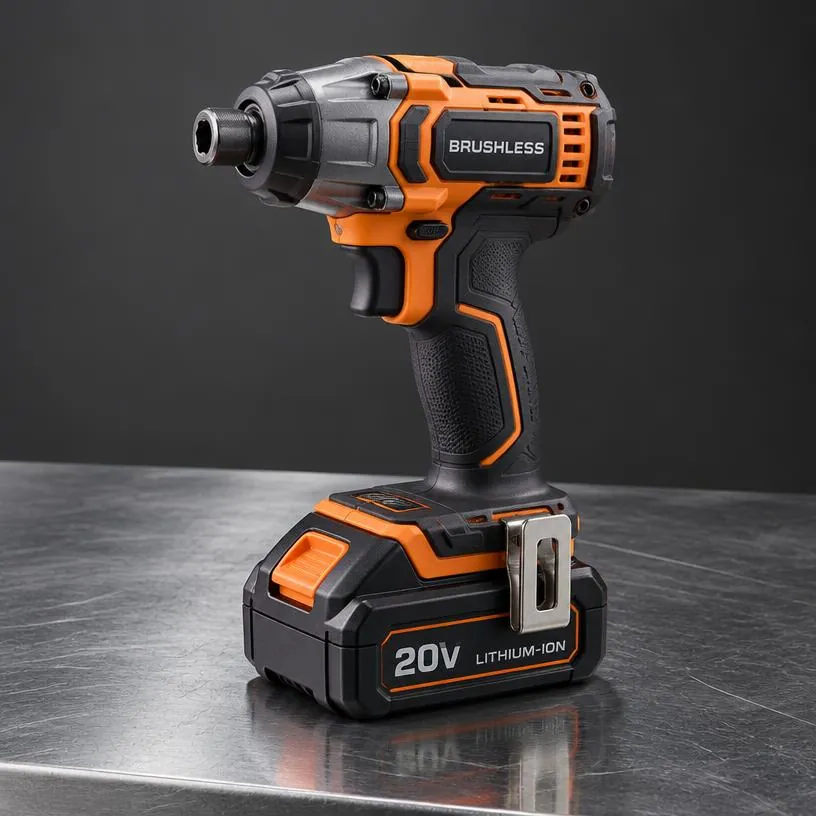 Save -32%18V Lithium Impact Driver KitSave -25%12V Compact Drill With 2 Batteries800W SDS Rotary Hammer
/ Frequently asked
Can an impact driver drill holes?+
Yes, with hex-shank drill bits, in wood and thin metal. It cannot take round-shank bits, hole saws over about 50mm, or give you the depth precision a drill's clutch does.
Will an impact driver strip screw heads?+
Less than a drill, as long as the bit matches the recess exactly and you use impact-rated bits. Most stripping comes from a worn PH2 bit in a PZ2 head.
Is 18V or 20V better?+
They are the same thing. 18V is the nominal voltage, 20V the peak reading off a freshly charged pack. Compare amp-hours and tool torque instead.