
Outdoor & Camping · 9 min read
Camp stoves in the cold: why your burner dies at 0C and how to fix it
Canister gas, liquid fuel and solid fuel compared for real winter conditions - vapour pressure, wind, boil times and the field tricks that keep water moving.
By OUTROOM Field Desk · Updated
Key takeaways
- Standard butane stops vaporising near 0C; isobutane/propane blends keep working to roughly -10C.
- Wind steals more heat than cold does. A windscreen is the cheapest performance upgrade you can carry.
- Liquid fuel stoves are unaffected by temperature but need priming and maintenance.
- Keep the canister warm, not hot: body heat or a shallow water bath, never a flame.
A canister stove that boiled a litre in three minutes in September can sputter out in January. Nothing is broken. The fuel inside is simply no longer turning into gas fast enough to feed the burner, and once the canister chills itself through evaporation the problem accelerates.
/ Vapour pressure, in one paragraph
Canister fuel is a liquid held under its own pressure. It burns as vapour, and it only produces vapour above its boiling point. Butane boils at -0.5C, isobutane at -11.7C, propane at -42C. As you burn fuel, evaporation cools the canister below ambient temperature - so a stove running at 3C can chill its own canister into the dead zone.
| Fuel | Works down to | Notes |
|---|---|---|
| Butane | About 0C | Cheap, widely sold, useless in winter |
| Isobutane/propane 80:20 | About -10C | The standard four-season canister blend |
| Propane (steel bottle) | -40C | Heavy, but unstoppable at car camps |
| White gas / naphtha | -40C | Pump-pressurised, needs priming and cleaning |
| Solid fuel tablets | Any | Slow, smoky, but weighs nothing as a backup |
/ Wind is the bigger thief
A 15 km/h breeze can double boil time and triple fuel use on an unshielded upright burner. Most of the heat never reaches the pot. A foil windscreen, a rock wall or simply cooking in the lee of a pack solves more cold-weather complaints than a fuel upgrade does.
/ Field fixes that work
- 01Sleep with the canisterOvernight in the foot of the sleeping bag means a warm start at breakfast, the meal that matters most.
- 02Insulate it from the groundFrozen soil or snow pulls heat straight out. A foam pad offcut under the canister is worth several degrees.
- 03Use a shallow warm-water bathTwo centimetres of water in a lid keeps the canister at water temperature while it runs.
- 04Rotate between two canistersSwap every few minutes and let the cold one recover in a jacket pocket.
- 05Go remote-canister with a pre-heat tubeInverted liquid-feed stoves burn fuel as liquid and shrug the whole problem off.
/ Melting snow without wasting fuel
- Always start with a splash of liquid water in the pot - dry snow on hot metal scorches and tastes burnt.
- Add snow in handfuls, not one packed block; loose snow transfers heat far faster.
- Lid on, always. An open pot at altitude can double the fuel needed for a litre.
- Budget roughly 15-20g of gas per litre of water melted and boiled from snow, against about 8g from liquid water.
Warm fuel, still air, a lid on the pot. Everything else is marketing.
- Winter field checklist
Field gear for cold-weather camps
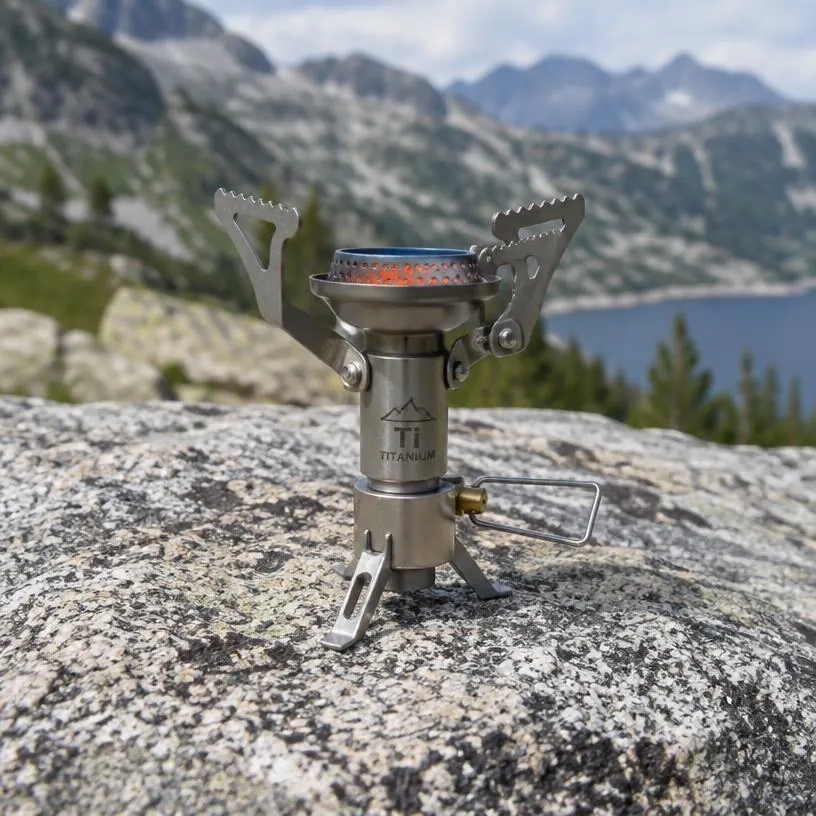 Save -23%Titanium Camping Stove1200 Lumen Rechargeable Headlamp
 Save -25%2-Person Wind-Resistant Tent
/ Frequently asked
Can I use a summer canister in winter?+
Down to about 5C with the warming tricks above. Below that, switch to an isobutane/propane blend or a liquid-fuel stove.
How do I know how much gas is left?+
Weigh it. Canisters are stamped with their empty weight; the difference from the current weight is your remaining fuel in grams.
Is it safe to cook in a tent vestibule?+
Only with full cross-ventilation, and never with a flame in an enclosed space. Carbon monoxide has no smell and builds fast in a sealed tent.